The Pattern Makes All the Difference
You’ve picked your material. You’ve chosen your color. But there’s one decision that shapes how your entire patio looks and performs, and most homeowners don’t give it nearly enough thought: the pattern.
Paver patterns aren’t just visual choices. They affect how your patio handles foot traffic, how stable the surface stays over time, and how well it holds up against 30A’s heat, rain, and sandy coastal soils. Get the pattern right, and your outdoor space looks intentional and polished. Get it wrong, and even premium materials can fall flat.
If you’re planning a new patio or refreshing an existing one, speaking with a paving contractor on 30A who knows the local environment is always a smart first move. But to get you oriented before that conversation, here’s a straightforward breakdown of the most popular patio paver patterns and how they perform in Florida’s coastal climate.
Why Pattern Choice Matters More in Florida
Most paver guides treat pattern selection as purely aesthetic. Along 30A, it’s also structural.
Sandy coastal soils shift more than inland clay-based ground. That movement puts stress on paved surfaces, especially at the joints. Some patterns interlock more tightly than others, distributing load more evenly and resisting shifting far better over time. So before you fall in love with a particular layout on a design website, it’s worth asking: how will this hold up ten years from now?
If you’re weighing material options at the same time, our breakdown of travertine vs. concrete pavers for hot climates covers exactly how each material behaves in Florida’s coastal conditions. This is a useful context before you lock in a pattern and material combination.
With that in mind, here are the patterns that consistently perform well on 30A properties.
The Most Popular Patio Paver Patterns
Herringbone
Herringbone is the gold standard for interlocking strength. Rectangular pavers are laid at alternating 45- or 90-degree angles, creating a tight zigzag that locks each piece against its neighbors. The result is a surface that distributes weight evenly and resists lateral movement.
For patios, herringbone works particularly well in:
- High-traffic areas like outdoor dining spaces and entertainment zones
- Patios that connect directly to pool decks or driveways
- Larger surface areas where structural stability matters most
Visually, herringbone reads as classic and refined. It pairs well with both traditional and contemporary home styles along 30A. If you’re unsure which pattern to choose, herringbone is rarely the wrong answer.
Running Bond
Running bond is a straightforward, linear layout where each row of pavers is offset by half a unit from the row above, similar to standard brickwork. It’s clean, modern, and easy on the eye.
This pattern works best for:
- Smaller patios where a simple layout feels proportionate
- Contemporary homes with architectural clean lines
- Spaces where you want the material to be the visual focus rather than the pattern
One thing to keep in mind: running bond doesn’t interlock as firmly as herringbone. For patios on well-compacted bases with quality edge restraints, it performs reliably. But it’s not the first choice for surfaces that take heavy or frequent traffic.
Basketweave
Basketweave pairs rectangular pavers in alternating horizontal and vertical groupings, creating a woven checkerboard effect. It’s a pattern with strong heritage appeal, often associated with Mediterranean and colonial-style architecture.
Along 30A, basketweave is a natural fit for:
- Courtyard-style patios surrounded by landscaping
- Shaded seating areas beneath pergolas or mature trees
- Properties with Old Florida or cottage-style aesthetics
It creates a lot of visual texture, which can feel busy in larger open spaces. Keep it for defined, smaller areas where its detail adds warmth rather than visual noise.
French Pattern (Versailles Pattern)
The French pattern uses four different paver sizes arranged in a repeating modular layout. The varied sizing creates an organic, old-world appearance that looks handcrafted even when it’s highly precise. Travertine is the most common material for this pattern, and the combination is practically synonymous with luxury coastal properties in Florida.
This pattern excels when:
- You want a high-end, resort-style feel
- The patio connects to a pool deck or spa area
- The home’s architecture has European or Mediterranean influences
It does require more planning and precise cutting at borders and corners, so professional installation is especially important here. The payoff, though, is a surface that looks genuinely distinctive rather than something picked from a standard catalog.
Stack Bond
Stack bond lays pavers in a clean grid with joints aligned both horizontally and vertically. It’s the most minimal and geometric of all the common patterns. Think of it as the architectural grid that modern design loves.
This pattern works well for:
- Strictly contemporary properties in Alys Beach or Rosemary Beach
- Large-format pavers where fewer joints are desirable
- Situations where the design brief calls for sharp, structured geometry
Stack bond is honest about its simplicity. It doesn’t hide its structure; it celebrates it. That said, aligned joints can be a weakness on unstable soils if edge restraints aren’t installed properly.
Random Ashlar
Random ashlar uses three or more different paver sizes arranged in an irregular but balanced layout. The result looks natural and unplanned, even though a skilled installer has carefully thought through every placement.
This pattern is a strong choice for:
- Patios designed to feel organic and connected to the surrounding landscaping
- Properties with a relaxed, beach-house aesthetic
- Natural stone materials like limestone or flagstone
It takes more time to install than standard patterns and requires an experienced eye to get the proportions right. But when it’s done well, random ashlar creates a patio that feels genuinely unique.
Choosing a Pattern for Your Specific Space
Not sure which direction suits your patio? This table can help you narrow it down quickly.
| Pattern | Best Visual Style | Structural Strength | Best Patio Size |
| Herringbone | Classic, versatile | Excellent | Any size |
| Running Bond | Modern, minimal | Good | Small to medium |
| Basketweave | Traditional, textured | Good | Small to medium |
| French Pattern | Luxury, Old World | Very good | Medium to large |
| Stack Bond | Contemporary, geometric | Moderate | Large |
| Random Ashlar | Organic, natural | Good | Any size |
Don’t Overlook the Border
A border is a single row (or two) of pavers that frames the outer edge of your patio in a contrasting color, size, or angle. It’s a finishing detail that makes the whole surface look intentional and professionally designed.
Common border approaches include:
- Soldier course — pavers laid lengthwise along the perimeter
- Sailor course — pavers laid widthwise, creating a wider border band
- Contrasting color — same pattern, different tone, to define the edge
Even a subtle border in a slightly darker or lighter shade adds enough visual definition to make a standard pattern look custom. It’s a small detail that delivers a noticeably better result.
How Pattern and Material Work Together
Pattern and material don’t operate independently. Some combinations work naturally; others don’t. Here are pairings that consistently produce great results along 30A:
- Travertine + French pattern — The classic luxury combination for coastal patios and pool deck areas. Stays cool underfoot, looks refined, and holds up beautifully in Florida’s climate.
- Concrete pavers + herringbone — The most reliable all-purpose combination. Strong, flexible in color options, and appropriate for almost any home style.
- Brick pavers + basketweave — A natural match. The warm tones and tactile finish of brick suit the woven texture of basketweave perfectly.
- Large-format concrete + stack bond — The go-to for contemporary properties where clean geometry and minimal joints are the design priority.
If you’re also thinking about extending your design to a patio paver space that connects your indoor and outdoor living areas, keeping the same pattern across both surfaces creates a cohesive flow that reads as genuinely designed. And if you’re adding a fireplace or fire pit to the patio layout, it’s worth knowing that fireplace and fire pit pavers benefit from the same pattern planning, particularly when the surrounding surface needs to anchor the feature visually.
Patterns That Work Well Beyond the Patio
Once you start thinking in patterns, it’s natural to want consistency across your entire outdoor space. The good news is that most patio patterns translate cleanly to adjacent surfaces.
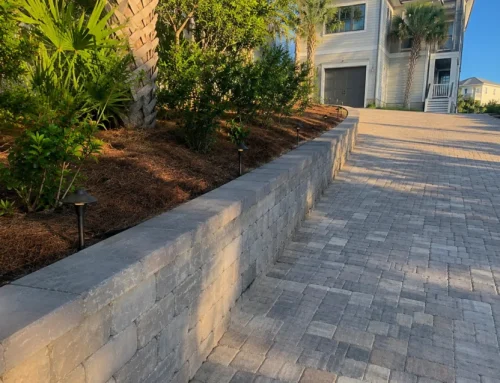
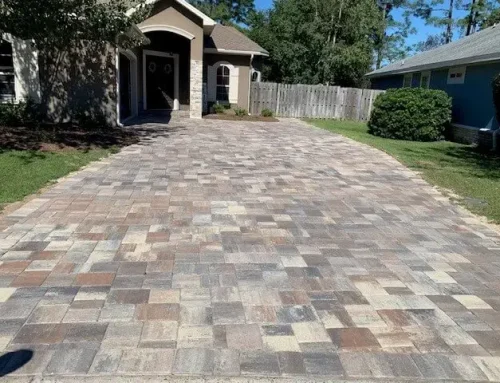
Herringbone, for instance, is just as strong a choice for a driveway paver layout as it is for a patio. Using the same pattern from the driveway through to the backyard creates a unified exterior that looks professionally planned rather than assembled over time. Similarly, if your property includes changes in grade, carrying a consistent pattern through your retaining wall paver design and adjacent patio surface ties the levels together visually. The same logic applies to outdoor steps and stair pavers. Matching the tread pattern to your patio surface makes transitions feel seamless rather than abrupt.
For homeowners thinking about a full outdoor living build, replacing concrete with pavers across multiple surfaces gives you the chance to apply a single cohesive pattern language throughout the entire property from the start.
Frequently Asked Questions
What’s the strongest paver pattern for a patio in Florida?
Herringbone offers the tightest interlock and best resistance to lateral movement, making it the most structurally reliable option. It’s especially recommended for high-traffic patios and surfaces on sandy coastal soils.
Is the French pattern worth the extra cost?
For homeowners who want a luxury, resort-style finish, yes. Travertine in a French pattern is one of the most visually distinctive combinations available for outdoor patios in Florida. The installation requires more skill and time, which adds to the cost, but the result is a surface that genuinely stands apart.
Can I use more than one pattern on a single patio?
Yes, and it’s actually a smart design move for larger spaces. Using a different pattern in a defined zone, like a dining area versus a lounge area, adds visual interest and helps segment the space without physical barriers.
What pattern works best for a small patio?
Running bond or basketweave tends to work best in smaller spaces. They don’t overwhelm the eye the way more complex patterns can, and they’re available in smaller paver formats that keep the proportions balanced.
Does the pattern affect how hot the patio gets?
The pattern itself doesn’t affect heat as much as the material and color do. Lighter materials like travertine and ivory-toned concrete reflect more sunlight and stay cooler underfoot regardless of the pattern used.
How does paver installation cost vary by pattern?
More complex patterns like French and random ashlar require additional labor time and more precise cuts, which typically add to the overall project cost. Simpler patterns like a running bond are generally more straightforward to install. Our guide on what affects paver installation cost on 30A breaks down the specific factors in detail.
Ready to Plan Your Patio?
The right paver pattern comes down to your home’s style, how you plan to use the space, and the specific conditions of your 30A property. If you’d like an expert opinion before making any decisions, the team at 30A Delta Pavers is happy to walk you through your options. Reach out to get a specialist’s perspective on what will actually work best for your outdoor space.