Most homeowners shopping for a new driveway along 30A know they want pavers. The durability, the curb appeal, the long-term value over plain concrete- those benefits are well established. But once you start researching, a second question tends to come up: should those pavers be permeable or traditional?
It’s a fair question, and the answer isn’t the same for every property. Your lot’s drainage profile, your HOA requirements, your proximity to coastal waterways, and your budget all factor into which system makes more sense. This guide puts both options side by side across the factors that matter most for a driveway in Florida’s coastal climate, so you can make a clear, informed decision before any work begins.
If you’d like a local expert to assess your specific property conditions before you decide, reaching out to a trusted asphalt paving company 30A or a paver specialist who knows the local environment is always a smart move.
The Core Difference in One Sentence
Traditional pavers shed water off the surface. Permeable pavers let water pass through the surface and into the ground below.
Everything else in this comparison flows from that single distinction. The drainage behavior of a driveway affects its base design, installation cost, maintenance requirements, and long-term performance in ways that matter a great deal in a high-rainfall coastal environment like 30A.
How Each System Handles Water
This is the most important factor for any driveway in Florida, and it deserves a thorough look.
Traditional pavers are installed over a compacted base of gravel and sand with joints filled tightly with polymeric sand. Rainwater hits the surface and runs off the edges, directed by the driveway’s slope toward drainage channels, swales, or the surrounding landscape. A properly graded traditional driveway manages water well. But the water doesn’t go away; it moves somewhere else, and on properties with limited drainage capacity or proximity to coastal waterways, that runoff can cause real problems.
Permeable pavers use wider joints filled with open-graded aggregate rather than packed sand. Water enters the joints and filters down through a deep aggregate base reservoir, where it temporarily stores and slowly infiltrates into the native soil below. On 30A’s sandy soils, that infiltration happens quickly and efficiently, which means the base reservoir recovers rapidly between rain events.
The practical difference during a Florida summer storm is meaningful. A traditional driveway sends all that rainwater somewhere else. A permeable driveway absorbs a significant portion of it on-site, reducing the load on surrounding drainage infrastructure and protecting adjacent landscaping from erosion.
For a fuller explanation of how permeable systems are engineered from the ground up, our guide on what permeable pavers are and how they work covers each layer in detail.
Installation: What’s Different Under the Surface
Both systems use interlocking paver units on the surface, so the visual installation process looks similar. The real differences are underground.
Traditional paver driveway base:
- Excavation to approximately 8 to 10 inches below finished grade
- Compacted gravel subbase, typically 4 to 6 inches deep
- Bedding layer of coarse sand, approximately 1 inch
- Pavers installed and joints filled with polymeric sand
Permeable paver driveway base:
- Excavation to approximately 18 to 24 inches below finished grade
- Deep open-graded stone reservoir, typically 12 to 18 inches deep
- Thin bedding layer of coarse aggregate, approximately 1 inch
- Pavers installed with wider joints filled with small angular aggregate
The deeper excavation and larger volume of aggregate material in a permeable system are what drive the higher upfront cost. It’s also why engineering matters more for permeable driveways: the base reservoir needs to be sized correctly for the driveway’s surface area and the local rainfall volume to function properly over time.
Cost Comparison
Let’s be direct about the numbers, because cost is one of the most common deciding factors.
| Factor | Traditional Pavers | Permeable Pavers |
| Typical cost per sq ft on 30A | $12 to $22 | $18 to $30 |
| Excavation depth | 8 to 10 inches | 18 to 24 inches |
| Base material volume | Standard | Significantly more |
| Separate drainage structures | Often required | Sometimes reduced or eliminated |
| Long-term maintenance cost | Low | Moderate |
| Lifespan | 25 to 50 years | 25 to 50 years |
The upfront cost difference is real. A permeable driveway on 30A typically costs 30 to 50 percent more per square foot than a comparable traditional installation. For larger driveways, that gap adds up quickly.
However, a few factors offset some of that difference. Properties that would otherwise need additional drainage infrastructure, such as French drains, dry wells, or extended swales, may find that a permeable driveway reduces or eliminates those costs. And on properties where Walton County or HOA drainage requirements apply, the cost of compliance with a permeable system may compare favorably to the cost of meeting those requirements through separate drainage work.
Neither system costs significantly more than the other to maintain over its lifespan, though their maintenance tasks differ. More on that below.
Durability and Load Capacity
A common concern about permeable driveways is whether the looser joint structure compromises the surface’s ability to handle vehicle loads. It’s a reasonable question. The answer is that a properly engineered permeable driveway handles standard residential vehicle loads, including SUVs, trucks, and boat trailers, without issue.
The key phrase is “properly engineered.” The aggregate base in a permeable system transfers vehicle load through the stone layers rather than relying on joint sand for stability, the way traditional pavers do. When the base is correctly sized and the right paver thickness is specified, the load capacity is comparable to a traditional installation.
Both systems share one important structural advantage over poured concrete: they flex slightly with ground movement rather than cracking as a rigid slab would. Along 30A, where sandy soils shift seasonally and after heavy rain events, that flexibility is a meaningful long-term benefit. The benefits of replacing concrete with pavers apply to both permeable and traditional systems for exactly this reason.
Maintenance: What Each System Requires
This is where the two systems diverge most in day-to-day ownership.
Traditional paver driveway maintenance:
Traditional driveways are relatively straightforward to maintain. The main tasks are periodic sweeping, occasional pressure washing, and resealing the polymeric sand joints every few years to prevent weed intrusion and joint erosion. Individual pavers can be lifted and replaced if cracked or stained, without disturbing the rest of the surface.
Permeable paver driveway maintenance:
Permeable driveways require those same basic cleaning tasks, plus one additional consideration: keeping the joints clear of sediment. Over time, fine particles, including sand, organic matter, and dust, can settle into the open aggregate joints and reduce the system’s ability to drain. In Florida’s environment, this happens faster near beaches and unpaved areas where fine sand is airborne regularly.
Joint maintenance typically involves periodic vacuuming with a specialized wet/dry vacuum or careful pressure washing to flush the joints. How often this is needed depends on site conditions, but once every one to two years is a reasonable expectation for most 30A properties.
One important distinction: when a joint in a traditional driveway fails, the fix is straightforward: re-sand and re-seal. When permeable joints become significantly clogged, restoration can be more involved. Staying ahead of sediment buildup with regular maintenance is much easier than trying to restore a system that’s been neglected for several years.
Appearance: Is There a Visual Difference?
For many homeowners, this matters as much as the technical performance factors. The good news is that the visual difference between permeable and traditional pavers is subtle when you’re looking at the finished surface from the street.
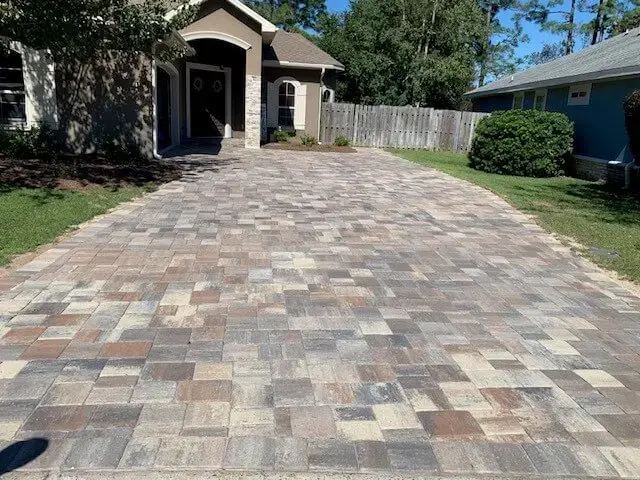
Both use the same paver units. Both are available in the same colors, sizes, and patterns, including herringbone, running bond, and stack bond. The primary visible difference is in the joints: permeable driveways have slightly wider joints with a coarser aggregate fill, rather than the tight, sand-filled joints of a traditional installation.
For most design styles along 30A, from coastal contemporary to Mediterranean-inspired, that joint difference reads as a texture variation rather than a design departure. Most homeowners and visitors wouldn’t identify the driveway as permeable without being told.
If consistent joint appearance is important from a design standpoint, a traditional driveway with tight polymeric sand joints has a marginally cleaner visual finish. But for most properties, the difference is minor enough that it shouldn’t be the deciding factor.
Which Driveway Is Right for Your 30A Property?
Here’s a practical decision guide based on the most common property scenarios along 30A.
Traditional pavers are likely the better fit if:
- Your property has well-established drainage and no history of water pooling near the driveway or foundation
- Your lot doesn’t sit near a coastal waterway, wetland, or flood zone
- Upfront cost is a primary constraint, and you’re comfortable with standard drainage management
- Your HOA or local requirements don’t mandate on-site stormwater management
- You prefer the tightest possible joint finish for aesthetic reasons
Permeable pavers are likely the better fit if:
- Your property has drainage challenges, a low spot that collects water, or a history of driveway runoff affecting adjacent areas
- Your lot is near a coastal waterway, wetland, or sits in a FEMA flood zone
- Your Walton County or HOA requirements include stormwater management provisions
- You’re investing in a vacation rental property where environmental credentials and low long-term maintenance are priorities
- You’d prefer to manage water on-site rather than redirect it to neighboring properties or drainage infrastructure
If you’re still unsure, a site visit from a local installer who can assess your drainage profile, soil conditions, and any applicable requirements is genuinely the most reliable way to get a clear answer. Both systems are excellent choices when matched correctly to the property they’re serving.
Frequently Asked Questions
Can permeable pavers handle heavy vehicles on a Florida driveway?
Yes, when properly engineered. A permeable driveway designed to ICPI standards with the correct paver thickness and base depth handles standard residential vehicle loads, including SUVs, trucks, and trailers, reliably. The load transfer happens through the aggregate base rather than through the joint material.
Do permeable driveways flood or back up during very heavy rain?
A correctly designed system includes an overflow provision, typically a perforated pipe at the bottom of the base reservoir, that directs excess water to an appropriate discharge point when rainfall volume exceeds the system’s infiltration capacity. This prevents the surface from flooding even during Florida’s most intense storm events.
How do permeable driveways hold up to salt air and coastal conditions?
The paver units themselves perform the same way as traditional pavers in coastal conditions. Salt air affects the surface material, not the drainage system below. Both permeable and traditional concrete pavers benefit from periodic sealing in high salt-exposure environments along 30A.
Will a permeable driveway satisfy Walton County stormwater requirements?
It depends on your specific property location and the applicable requirements. Permeable paving is recognized as a best management practice for stormwater reduction, and it can satisfy or partially satisfy requirements in many cases. Confirm with Walton County Planning and Development and your HOA before making assumptions.
Are there HOA restrictions on permeable driveways along 30A?
Some HOAs along 30A have specific requirements about driveway materials, finishes, and joint appearance. Most permeable systems meet standard appearance requirements since the visual difference from traditional pavers is subtle. It’s worth reviewing your HOA guidelines before committing to either system.
How long before a permeable driveway needs joint restoration?
On a well-maintained 30A property with regular sweeping and annual joint vacuuming, permeable driveways typically go five to ten years before needing any significant joint restoration. Properties near beach access points or unpaved areas may need attention sooner due to higher airborne sand levels.
Ready to Decide?
Both permeable and traditional paver driveways are strong long-term investments for 30A properties. The right choice depends on your drainage situation, your site conditions, and your priorities as a homeowner. The team at 30A Delta Pavers can assess your property, walk you through both options honestly, and help you choose the system that actually fits your needs. Contact us to get a specialist’s perspective before you commit.