You’ve spent serious money on a pool. The last thing you want is a deck surface that burns your feet in July, goes slippery when wet, or starts showing wear after two seasons of Florida sun and saltwater exposure.
Two surfaces come up most often in this conversation along 30A: cool deck coatings and travertine pavers. Both promise comfort underfoot. Both are commonly installed on Florida pool decks. But they’re fundamentally different products with different performance profiles, installation requirements, and long-term costs.
If you’re trying to choose between them, this breakdown covers what actually matters for coastal Florida conditions, heat performance, safety, durability, maintenance, and cost, so you can make an informed decision before work begins. And if you’d like a local perspective on what performs best on 30A properties specifically, working with a trusted residential paving contractor 30A homeowners rely on is always a smart first step.
What is Cool Deck, Exactly?
“Cool deck” is a term that gets used loosely, but it specifically refers to a spray-applied acrylic or cementitious coating that goes over an existing concrete slab. The textured surface it creates has tiny peaks and valleys that reduce direct foot contact with the hot concrete beneath, which helps lower the perceived surface temperature.
It was developed in the 1960s and became extremely popular in Arizona and Florida, where pool deck heat is a genuine daily issue. The Kool Deck brand became so well known that “cool deck” is now used as a generic term for this category of coating, similar to how “Kleenex” describes any facial tissue.
Cool deck is not a paver. It’s a surface treatment applied over concrete. That distinction matters because it shapes everything from how it’s installed to how it ages and what happens when it needs repair.
What is Travertine?
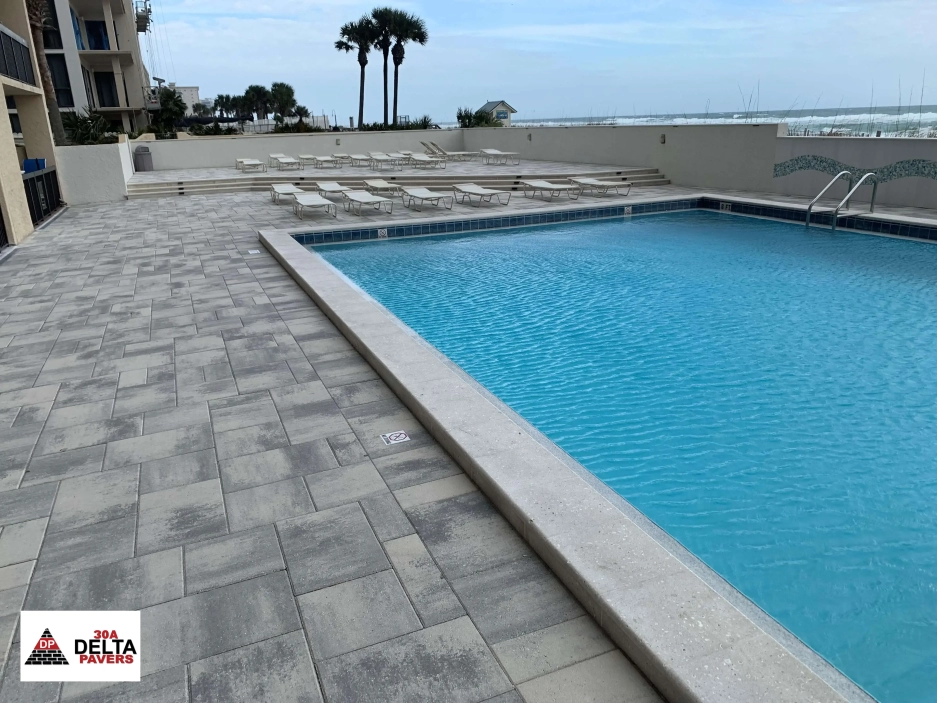
Travertine is a natural limestone formed around mineral springs. It’s been used as a building material for thousands of years and remains one of the most popular choices for luxury pool decks in Florida. Its porous internal structure is what sets it apart; those tiny air pockets within the stone dissipate heat rather than absorbing it, which is why travertine stays noticeably cooler underfoot than most other hard surfaces in direct sun.
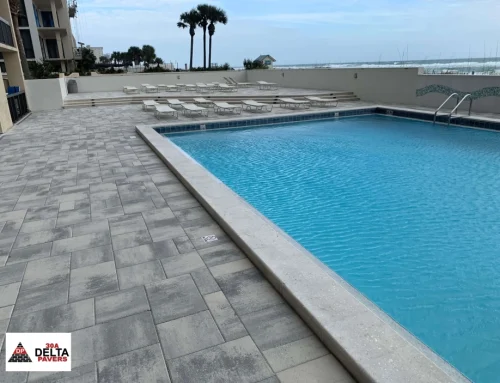
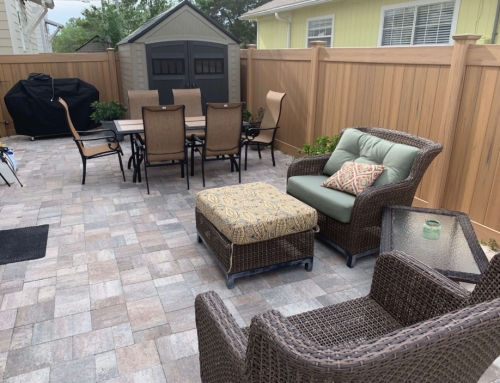
On 30A, travertine is the material of choice on many higher-end residential and vacation rental properties. Its warm ivory, cream, and sand tones suit coastal architecture naturally, and it pairs seamlessly with pool deck paver designs that extend to patios, spas, and outdoor living areas.
Head-to-Head Comparison
Heat Performance
This is where the two surfaces differ most noticeably.
Travertine’s porous structure genuinely disperses heat. Even on peak summer afternoons along 30A, light-colored travertine stays walkable barefoot in a way that most other hard surfaces simply don’t. The color matters too; ivory and cream tones reflect far more sunlight than darker options.
Cool deck coatings work differently. The textured surface reduces how much of your foot makes contact with the hot concrete below, which reduces the perceived heat. But the concrete substrate still absorbs heat throughout the day, and by mid-afternoon on a full-sun deck, a cool deck coating can still get genuinely uncomfortable to stand on for extended periods.
Edge: Travertine, particularly for full-sun pool decks in Florida’s peak summer months.
Slip Resistance
Both surfaces offer reasonable traction when dry. The real test is wet performance, and that’s where the differences show up.
Travertine’s natural texture and porosity provide good grip even when wet, as long as it hasn’t been sealed with a high-gloss finish. A non-slip sealer or a natural honed finish maintains that traction reliably. It’s one of the primary reasons travertine is recommended for pool surrounds, pool decks, and spa areas where wet feet are constant.
Cool deck coatings are specifically designed for slip resistance. The spray texture creates a grippy surface that performs well both wet and dry. For families with young children, the reliable traction of a fresh, cool deck coating is genuinely effective.
Over time, though, cool deck coatings wear down with foot traffic and UV exposure. As the texture fades, so does the traction. Travertine’s grip comes from the stone itself and doesn’t degrade the same way.
Edge: Tie when new, travertine over time.
Durability in Coastal Florida Conditions
This is where the two products diverge most significantly for 30A homeowners.
Travertine is a natural stone. Properly installed and sealed, it handles salt air, chlorine splash, UV exposure, and Florida’s heavy rainfall without structural degradation. Individual pavers can be lifted and replaced if damaged, without disturbing the rest of the deck. That repairability is one of travertine’s biggest practical advantages. The benefits of replacing concrete with pavers go well beyond aesthetics. Paver surfaces flex slightly with ground movement rather than cracking as a rigid slab would.
Cool deck coatings are applied over a concrete slab, and that slab’s longevity determines the coating’s longevity. Florida’s sandy soils shift, concrete cracks, and when the substrate moves, the coating above it cracks too. Repairing a cracked cool deck coating is possible, but matching the texture and color of an aged coating is notoriously difficult. After several repairs, the surface often looks patchy. A full recoat is typically needed every 5 to 10 years.
Edge: Travertine, for long-term durability and repairability.
Maintenance Requirements
Neither surface is maintenance-free in Florida’s coastal environment.
Travertine needs periodic sealing, typically every two to three years, to protect against saltwater exposure, pool chemicals, and staining. Regular sweeping and occasional pressure washing keep it looking clean. The maintenance is straightforward, and skipping a sealing cycle doesn’t immediately ruin the surface.
Cool deck coatings require cleaning to prevent algae and mildew buildup in Florida’s humid climate. The coating will fade and chalk over time with UV exposure, and the textured surface can trap debris in ways that are harder to clean than a smooth paver. Full recoating every 5 to 10 years is a realistic expectation.
Edge: Roughly equal, with different maintenance tasks for each.
Aesthetics and Design Flexibility
Travertine has a natural, high-end appearance that reads as genuinely luxurious. Its warm tones, natural variation, and tactile quality give pool decks a resort-like feel that’s hard to replicate with a coating. It also extends beautifully to adjacent spaces; the same material can flow from the pool deck to a patio paver area, creating a cohesive outdoor environment throughout the property.
Cool deck coatings offer less design flexibility. They come in a range of colors, but the spray-applied texture has a consistent, uniform appearance that reads as a coating rather than a premium material. For homeowners focused primarily on budget and function, that’s perfectly fine. For properties where visual quality matters, vacation rentals, luxury homes, and properties where resale value is a priority, travertine delivers a noticeably higher-end result.
Edge: Travertine for design quality and flexibility.
Cost
Cool deck is the more affordable option upfront. Recoating an existing concrete slab with a cool deck product typically costs considerably less than installing travertine pavers, which require excavation, base preparation, and skilled installation.
However, the long-term cost picture is more balanced. Travertine’s 25 to 40-year lifespan with routine maintenance compares favorably against cool deck coatings that need full reapplication every 5 to 10 years. Over a 20-year window, the total cost of ownership often favors travertine, particularly on larger decks where recoating costs add up.
Edge: Cool deck for upfront cost. Travertine for long-term value.
Side-by-Side Summary
| Factor | Cool Deck | Travertine Pavers |
| Heat performance | Good when new | Excellent, consistent |
| Slip resistance | Excellent when new, fades over time | Very good, stable long-term |
| Durability | 5–10 years per coat | 25–40+ years |
| Repairability | Difficult to patch seamlessly | Individual pavers replaceable |
| Maintenance | Cleaning, periodic recoating | Sealing every 2–3 years |
| Aesthetics | Functional, uniform | Natural, high-end |
| Upfront cost | Lower | Higher |
| Long-term value | Moderate | Strong |
Which One is Right for Your 30A Property?
The honest answer depends on your budget, your timeline, and how you’ll use the space.
Cool deck makes sense if:
- You’re working with an existing concrete slab that’s in good structural condition
- Budget is the primary constraint, and a recoat in 5 to 10 years is acceptable
- The pool sees moderate use, and the deck isn’t a major visual focal point of the property
Travertine makes more sense if:
- You’re building a new deck or replacing a deteriorating deck surface
- The property is a vacation rental or high-use home where appearance and comfort drive repeat bookings or resale value
- You want a surface that flows seamlessly to adjacent outdoor living areas without visual breaks
- Long-term value and repairability matter more than upfront cost
Along 30A, where outdoor living is central to property value, and the rental market is competitive, travertine is the more common choice among homeowners who are thinking beyond the immediate project. That said, both surfaces have their place, and the right answer for your specific property depends on factors a local expert can assess in person.
Frequently Asked Questions
Is travertine really cooler than Cool Deck?
In most real-world conditions, yes. Travertine’s porous structure disperses heat naturally, while cool deck coatings reduce perceived heat through texture. On peak summer afternoons in full Florida sun, travertine typically stays more comfortable underfoot than a cool deck coating over a heat-absorbing concrete slab.
How long does Cool Deck last in Florida?
With regular cleaning and care, a cool deck coating typically lasts 5 to 10 years before needing a full recoat. UV exposure, foot traffic, and Florida’s humidity accelerate wear compared to drier climates.
Does travertine get slippery around pools?
Not when it’s properly finished. A honed or tumbled travertine finish provides good wet traction. Avoid high-gloss sealers in pool areas, as they reduce grip. A non-slip sealer additive is a smart choice for any pool deck application.
Can a cool deck be applied over travertine or pavers?
A coating can technically be applied over other surfaces, but it’s generally not recommended as a long-term solution. Coatings perform best over a solid, well-prepared concrete substrate.
How often does travertine need to be sealed near a saltwater pool?
In 30A’s coastal environment with saltwater pool exposure, sealing every one to two years is a reasonable schedule. Standard freshwater pool environments typically allow for a two to three-year interval between sealings.
Ready to Choose the Right Surface?
Both cool deck and travertine can serve a 30A pool deck well. The decision comes down to your budget, your property’s use, and how long you’re planning to stay ahead of maintenance cycles. If you’d like an expert to assess your specific pool deck and walk you through the options that make the most sense for your property, the team at 30A Delta Pavers is ready to help. Contact us to speak with a specialist before you commit to a surface.